
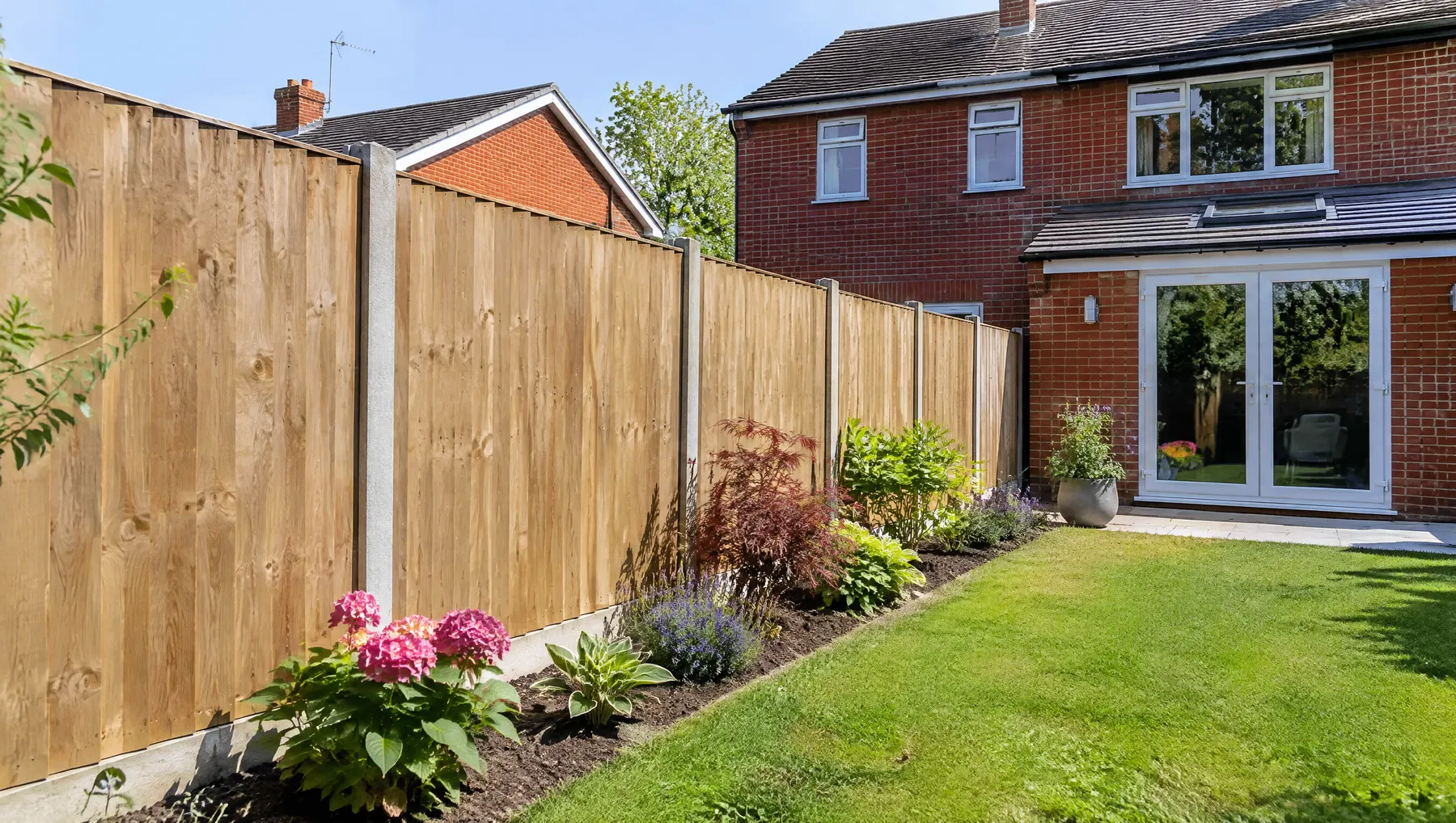
In England you can put up a garden fence up to 2 metres high without planning permission, measured from ground level. If the fence is next to a highway used by vehicles, or the footpath beside one, the limit drops to 1 metre.
Those limits come from householder permitted development rights, as set out by the Planning Portal. They do not apply everywhere: listed buildings, some conservation areas and homes where rights have been removed are different. Here is what you need to know before ordering panels.
The rules in one table
| Where the fence goes | Maximum height without planning permission |
|---|---|
| Back or side garden, not next to a road | 2 metres |
| Next to a highway used by vehicles, or its footpath | 1 metre |
| Beside a footpath or alley not used by vehicles | 2 metres |
| Listed building, or within its grounds | Planning permission needed, plus possibly listed building consent |
| Where the council has removed these rights (an Article 4 direction or planning condition) | Planning permission needed |
| Repairing or altering an existing fence without making it taller | Usually fine, even if it is already over the limit; check with your council if you are rebuilding it completely |
What counts as next to a highway?
A highway used by vehicles means a road, including the pavement alongside it. So a front garden fence on a typical residential street is limited to 1 metre. A side fence on a corner plot that runs along a road usually falls under the same 1 metre limit.
A back fence onto a pedestrian alley, a footpath across a field or a canal towpath is not next to a road used by vehicles, so the 2 metre limit normally applies. If your boundary sits near a road but is set back behind a verge or a hedge, check with your council how they read it.
How fence height is measured
Height is measured from ground level where the fence stands. On flat ground that is simple. On sloping gardens, or where your neighbour's ground is higher or lower than yours, it gets harder. On a slope, step the panels so that each section stays within the limit.
If the ground is very different on each side, ask your council how they will measure before you build. A fence that is 2 metres on your side and 2.4 metres on your neighbour's lower side is the kind of thing that upsets neighbours, so we step panels on a slope to keep it even.
Does trellis count?
Assume it does. The limit applies to the overall height of the structure, so a 1.8 metre panel with a 30 cm trellis topper comes to 2.1 metres, which is over the permitted limit. The same goes for concrete gravel boards at the bottom and post caps on top.
The neat answer is to use a shorter panel with trellis on top, so the total stays at 2 metres. A 1.5 metre panel with 30 cm of trellis plus a gravel board usually works out about right, but always measure the finished height.
Listed buildings and conservation areas
If your home is a listed building, or the fence is within its grounds, permitted development does not cover new fences and you will need planning permission. Listed building consent may also be needed.
In conservation areas the Planning Portal notes that you might need permission to take down a fence, wall or gate. Some conservation areas also have extra rules that remove the right to put up boundaries without permission. There are conservation areas in Kenilworth, Warwick and parts of Coventry, Solihull and Birmingham, so if you live in an older part of town, it is worth checking.
What if you want a fence higher than 2 metres?
You can apply for planning permission. Councils will look at the effect on neighbours' light and outlook and on the street scene. A 2.4 metre fence for privacy at the back of a house is sometimes approved, while a tall fence along a front boundary rarely is.
If you are not sure whether your fence needs permission, you can apply for a Lawful Development Certificate. Government guidance explains that this confirms whether proposed works are lawful, which gives you something in writing.
Hedges, neighbours and boundaries
Hedges do not need planning permission, but tall evergreen hedges are covered by separate rules.
Before replacing a boundary fence, it is worth talking to your neighbour, especially if you are not sure who owns it. GOV.UK advises getting legal advice if there is a dispute about where the exact boundary lies.
Before you order a new fence
- Check whether your home is listed or in a conservation area.
- Work out whether the fence runs next to a road used by vehicles.
- Measure the total height, including gravel boards, trellis and post caps.
- Talk to your neighbour and agree where the boundary is.
- Apply for permission, or a Lawful Development Certificate, if anything is unclear.
Getting it built
On our free site visit we measure the run, look at the ground levels and flag anything that could take you over the height limits. Our fence installation page explains the fence types we put up, and if you need a way through, see our garden gates page. Got a fence that has blown down or is leaning? Our fence repair service may get it back up without a full replacement. When you are ready, ask for a free quote.
Frequently asked questions
Can I put a 6 foot fence up without planning permission?
Usually, yes. Six feet is about 1.83 metres, which is under the 2 metre limit for fences that are not next to a road used by vehicles. Next to a road, the limit is 1 metre. Listed buildings and areas with removed rights are different.
Does trellis on top of a fence count towards the height?
Assume it does. The limit applies to the total height of the structure from ground level, so trellis, gravel boards and post caps all add to it. Use a shorter panel if you want trellis on top and stay within 2 metres.
How high can a front garden fence be?
If the front garden borders a road used by vehicles, or its pavement, the limit is 1 metre without planning permission. Anything taller along the front needs permission, and councils often refuse tall front fences because of the effect on the street.
Do I need permission for a fence in a conservation area?
The same height limits normally apply, but you might need permission to take down an existing fence, wall or gate, and some areas have extra rules removing the right to build boundaries. Check with your council before starting, or ask us to check at the site visit.