
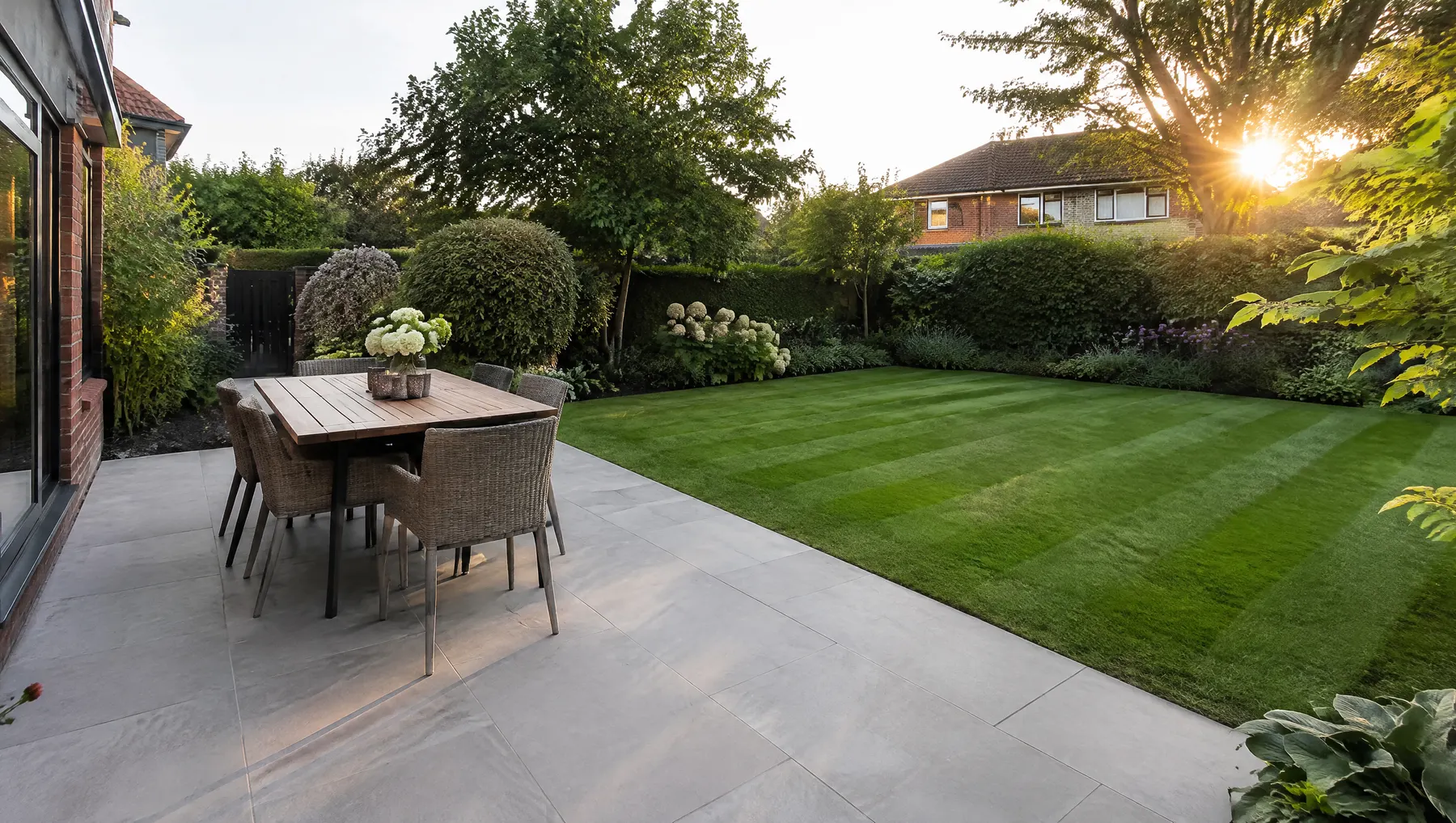
Patio installers across the West Midlands
Porcelain and natural stone patios, laid to stay level.
EVC lays new patios across Coventry and the West Midlands, with over 13 years' experience. We work with porcelain, Indian sandstone, limestone and slate, and every patio starts with a free site visit to check the levels, the ground and where the rain will drain. You get a fixed price in writing before we dig, and we leave the garden tidy with the waste taken away.
Patios that stay flat, dry and level
A patio that rocks, puddles or stains usually has a problem underneath: slabs spot-bedded on blobs of mortar, a thin base on clay, or no fall to carry the water away from the house.
We lay every slab on a full mortar bed over a compacted sub-base, and set the levels so the patio falls gently away from your walls and sits at least 150 mm below the damp-proof course.
Each stone gets the method it needs. A porcelain patio is primed slab by slab so the mortar grips, and sandstone faces are kept clean as we lay so mortar does not stain them.
- Over 13 years' experience, based in Coventry, covering the West Midlands.
- Every slab laid on a full mortar bed, never spot-bedded.
- Finished paving set at least 150 mm below the damp-proof course.
- Porcelain slabs primed before laying so the mortar bonds.
- Every patio quote follows a free site visit and is a fixed price.
Porcelain, sandstone, limestone or slate?
| Porcelain | Indian sandstone | Limestone | Slate | |
|---|---|---|---|---|
| Look | Uniform, many finishes | Natural variation | Even, refined | Dark, dense |
| Soaks up stains | Hardly at all | Yes, can mark | Less than sandstone | Very little |
| Maintenance | Sweep and rinse | Occasional clean, can green over in shade | Avoid acidic cleaners | Low |
| Read more | Porcelain patios | Natural stone patios | Natural stone patios | Natural stone patios |
Choosing your paving
The two most popular choices in West Midlands gardens are porcelain and Indian sandstone, with limestone and slate for a darker or more modern look. The table on this page compares them.
Porcelain is dense, stain resistant and very low maintenance, with consistent colour and size. Indian sandstone has natural variation and a softer, more traditional look, in riven or sawn finishes. Limestone is finer grained and calmer in appearance, and slate is dark and dense.
Our porcelain patios and natural stone patios pages go into each one, and our guide on porcelain vs Indian sandstone helps if you are torn between the two.
Planning the patio around your garden
The best patios are planned around how you use the garden. Think about where the sun is in the evening, where the table and chairs will go, and how you walk from the back door to the lawn.
On the site visit we look at the levels across the garden, where the drains and manholes sit, and how close the patio will be to the house. Sloping gardens often need steps or a retaining edge to create a level area, and we include those in the quote.
- Where the sun falls at the times you will use it
- Room for a table, chairs and space to move around them
- Steps and level changes down to the lawn
- Manhole covers, drains and downpipes in the way
- Shade from trees and fences, which affects algae growth
How we lay a patio
The groundwork takes the most time and decides how long the patio lasts. On clay ground, which is common round here, a well compacted base stops the slabs sinking unevenly over the years.
Once the slabs are down, the joints are filled with a cement mortar or a brush-in jointing compound, depending on the paving and the look you want. We finish edges, steps and the line where the patio meets the lawn so the job looks complete.
- Dig out turf, soil or old paving and take it away
- Lay and compact a crushed stone sub-base
- Set levels with a gentle fall away from the house
- Prime slabs where the material needs it
- Lay each slab on a full, wet mortar bed
- Joint, clean down and finish edges and steps
Drainage and the damp-proof course
A new patio must not send rain towards your house. We build in a gentle fall so water runs to the lawn, a border or a drain, and where a patio has to fall towards the house we plan a channel drain along the edge.
It also has to sit low enough. The finished paving should be at least 150 mm below the damp-proof course, the waterproof layer near the bottom of your walls, or rain splashing off it can cause damp inside. Sometimes that means digging deeper than you would expect, and we allow for it in the quote.
What affects the cost of a new patio
Size and slab choice are the obvious factors, but groundwork, levels, steps and access often move the price just as much. A garden that can only be reached through the house takes longer than one with wide side access.
Our patio cost page explains each cost driver and the questions to ask when comparing quotes. We do not publish a price per square metre, because it would not fit most gardens. After a free site visit, you get one fixed price. Ready to book? Use our quote form, or get in touch with questions.
From first question to signed off
Book a free site visit
Tell us about your garden on our quote form and we arrange a time to visit.
Fixed quote
We measure up, check levels and drainage, and give you one written price.
Groundwork
Dig out, sub-base and levels set so the water runs away from the house.
Laying and finishing
Slabs laid, jointed and cleaned down. We tidy up and take the waste away.
What is included
- Free site visit and advice on the right paving
- Dig out and removal of turf, soil or old paving
- Compacted sub-base and falls away from the house
- Slabs laid on a full mortar bed, primed where needed
- Joints filled with mortar or jointing compound
- Edges, steps and lawn edges finished
- Tidy-up and waste taken away
Patios FAQs
Which is better, porcelain or Indian sandstone?
Porcelain is lower maintenance and more uniform. Indian sandstone has more natural character and a softer, traditional look. Both make good patios, and we talk you through the pros and cons of each at the site visit.
How long does it take to lay a patio?
It depends on the size, the groundwork, steps and access. We give you a timescale with the quote and plan around the weather.
Do I need planning permission for a patio?
Not for a back garden patio in most cases. Paving more than 5 square metres of a front garden can need permission unless the rain drains into the garden, and we plan the drainage so it does.
Can you lay a patio on a sloping garden?
Yes. We create level areas with steps or retaining edges and include them in the quote after the site visit.
Do patios need sealing?
Porcelain does not. Natural stone can be sealed to reduce staining and slow algae, but it is optional and we will tell you whether it suits your stone.
Do you take away the old patio and soil?
Yes. Lifting the old paving, digging out and taking the waste away is part of the job.
Ready to talk about patios?
Answer a few questions and we will come back with a free, fixed quote.