
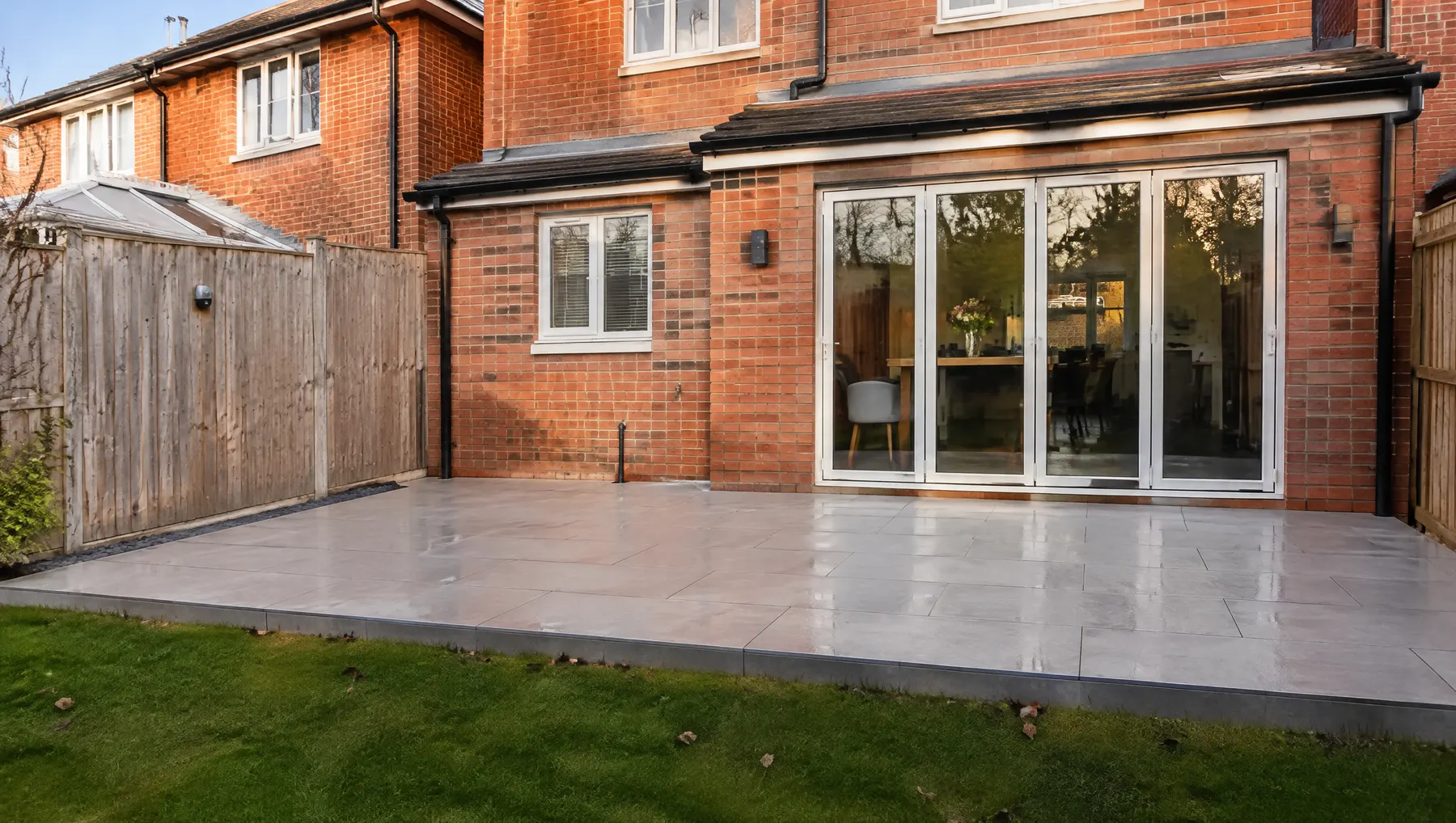
Porcelain patios
Crisp, low-maintenance paving, laid the way porcelain needs.
Porcelain paving has become the go-to patio for a lot of gardens. It is dense, hard wearing, barely absorbs water and comes in finishes from clean modern greys to convincing stone and timber effects. It is also less forgiving to lay than sandstone. We install porcelain patios across Coventry and the West Midlands, starting with a free site visit and a fixed quote before any work begins.
Why choose a porcelain patio?
Porcelain is fired at very high temperatures, which makes it dense and close to non-porous. In practice that means spilled wine, barbecue fat and leaf stains sit on the surface instead of soaking in, and algae has much less to grip than on natural stone.
It also stays the colour you chose. Because the colour is fired in, it does not fade in the sun the way some natural stone does.
- Low maintenance: a sweep and a rinse keeps it clean
- Stain resistant because it absorbs very little water
- Consistent colour and size, slab to slab
- Wide choice of finishes, including stone and wood effects
- Outdoor ranges come with a textured surface for grip
Porcelain is laid differently
This is where a lot of porcelain patios go wrong. Because porcelain absorbs almost nothing, ordinary mortar does not bond to the back of it the way it does with sandstone. Slabs laid like natural stone can sound hollow, rock or lift within a year or two.
We prime the back of every slab with a bonding slurry and lay it onto a full, wet mortar bed, not spots of mortar. Cuts are made wet so the edges stay clean and chip-free. It takes longer than laying sandstone, and it is the reason the slabs stay put.
Groundwork, falls and drainage
Under the paving, a patio needs a compacted sub-base and a firm, level bed. That is what stops it settling unevenly as clay ground moves through the year.
Every patio needs a gentle fall so rain runs off, away from the house, towards the lawn, a border or a drain. Next to the house, the finished paving should sit at least 150 mm below the damp-proof course so water does not bridge into the walls. We check both on the site visit.
Joints and finishing
Porcelain looks best with narrow, consistent joints. We fill them with either a brush-in jointing compound or a cement mortar, depending on the slab, the look you want and how the patio drains.
Edges, steps and the line where the patio meets the lawn are where the quality shows. We finish them with matching step treads, edging or a mowing strip so the patio has a proper finished edge.
Porcelain or Indian sandstone?
Both make great patios. Porcelain is lower maintenance and more uniform. Sandstone has natural variation, a softer, more traditional look, and is more forgiving to lay. Our guide on porcelain vs Indian sandstone compares them in detail, and our natural stone patios page covers sandstone, limestone and slate.
For what affects the price, see patio cost.
Porcelain patios across the West Midlands
We are based in Coventry and lay patios right across the region. We do a lot of patio installation in Solihull, plus Birmingham, Redditch, Bromsgrove and Coventry. See all our patio services.
What happens, step by step
Free site visit
Book on our quote form. We measure up, check levels and talk through slab choices.
Fixed quote
One written price for the whole patio, groundwork to jointing.
Groundwork
Dig out, sub-base and levels set with the right falls.
Laying and jointing
Slabs primed, laid on a full bed, cut, jointed and finished. We tidy up and take the waste away.
What is included
- Free site visit, measure-up and fixed written quote
- Dig out and removal of soil and old paving
- Compacted sub-base and level mortar bed
- Every slab primed and laid on a full, wet mortar bed
- Clean wet-cut edges and neat, consistent joints
- Falls set away from the house
- Tidy-up and waste taken away
Porcelain patios FAQs
Is porcelain paving slippery?
Outdoor porcelain is made with a textured surface for grip. Like any paving, it can be slippery with algae or ice on it, but because it absorbs so little water, algae has less to grip than on sandstone. Choose an outdoor-rated slab, not an indoor tile.
Why do porcelain slabs need priming?
Porcelain absorbs almost no water, so ordinary mortar struggles to bond to it. A bonding primer on the back of each slab creates the grip it needs. Skip it, and slabs can sound hollow or lift.
How long does it take to lay a porcelain patio?
It depends on the size, the groundwork and the number of cuts. Porcelain takes a little longer to lay than sandstone because of the priming and careful cutting. We give you a timescale with the quote.
Does porcelain paving fade?
Good quality outdoor porcelain holds its colour well, because the colour is fired in. That is one of the main reasons people choose it over natural stone.
Can porcelain be laid over an existing patio?
Only if the existing patio is sound, level, well bonded and leaves enough height below the damp-proof course. Often it is better to lift it. We check on the site visit.
How do I clean a porcelain patio?
A sweep and a rinse with water and a mild detergent is usually enough. Avoid harsh acids unless the slab manufacturer recommends them.
Porcelain patios near you
We cover the whole West Midlands from Coventry. Pick your town for local details.
Get a fixed price for the job
Tell us what you need and we will come back with a free quote.