
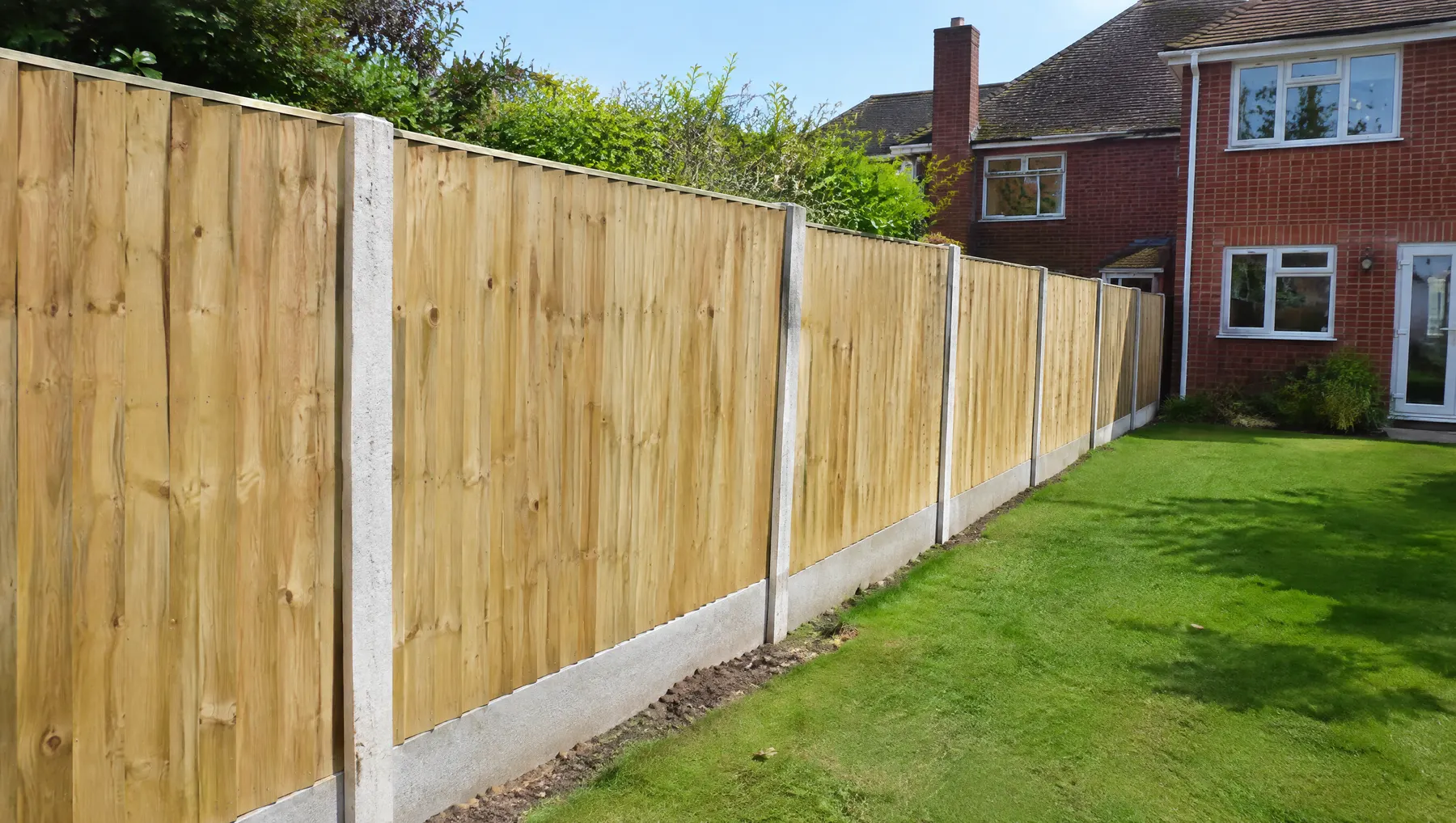
Fence installation
Garden fencing built straight, solid and ready for the wind.
A new fence should stand up to winter storms without leaning or losing panels. We install close board, panel and featheredge garden fencing across Coventry and the West Midlands, on concrete or timber posts with gravel boards to keep the timber off the soil. With over 13 years' experience, we start with a free site visit, agree a fixed quote before any work starts and take the old fencing away.
Types of garden fencing we install
Most garden fencing in the West Midlands is one of three styles. They look different and they behave differently in the wind, so it is worth knowing which is which before you choose.
Close board, fence panels or featheredge?
| Close board | Fence panels | Featheredge panels | |
|---|---|---|---|
| How it is built | Overlapping featheredge boards nailed on site to rails between posts | Ready-made panels slotted or fixed between posts | Pre-made panels faced with overlapping featheredge boards |
| Strength | The strongest timber option | Depends on the panel; lap panels are the lightest | Stronger than lap panels |
| Privacy | Full | Full with lap or closeboard panels | Full |
| Repairs | Single boards can be replaced | Swap the panel | Swap the panel |
| Good for | Exposed gardens, long runs, slopes | Quick, tidy boundaries on level ground | A close board look with panel convenience |
Close board and featheredge fencing
Close board fencing is built on site. We set the posts, fix horizontal rails between them, then nail overlapping featheredge boards vertically along the rails. Because it is built in place, it follows the ground on a slope and has no weak panel edges for the wind to catch.
It takes longer to put up than panels, which shows in the price, but it is the fence we recommend for exposed gardens, long boundaries and anywhere a fence has blown down before.
Concrete posts and gravel boards
Posts and the bottom of the fence are where most fences fail. Timber posts rot at ground level, and boards that touch the soil soak up water and decay.
Slotted concrete posts do not rot, and panels sit in the slots so they can be lifted out and replaced without disturbing the posts. Concrete gravel boards along the bottom keep the timber clear of the ground, which really helps on clay soil that stays wet all winter. Timber posts are still a good choice for close board fencing or where you prefer an all-wood look, and we set them properly in concrete.
- Concrete posts: will not rot, panels slot in and lift out
- Timber posts: natural look, best for close board, set in concrete
- Concrete or timber gravel boards: keep panels and boards off wet soil
How high can a garden fence be?
You can usually put up a fence up to 2 metres high without planning permission. Next to a road used by vehicles, or the footpath beside it, the limit is 1 metre. Listed buildings, and homes where the council has removed these rights, need permission.
Height is measured from the ground, and trellis fixed on top usually counts towards the total, so a 1.8 metre fence with 30cm of trellis is over the limit. We check all of this at the site visit, and our guide on how high a garden fence can be explains the rules in more detail.
Boundaries and neighbours
Before we fit a new fence on a boundary, it helps to know whose boundary it is. Your title plan or deeds may show it, though they are often not detailed. It is always worth talking to your neighbour before a fence goes up, especially if the old one is being replaced on the same line.
The usual courtesy is for the smooth face of the fence to face your neighbour and the posts and rails to sit on your side. We will check the line with you at the site visit and set out the posts before any digging starts.
What affects the price
We give you a fixed quote after measuring up. The main things that move the price are the length and height of the run, the style of fencing, concrete or timber posts, access to the garden, and whether the old fence has to come down and go. Slopes and steps in the ground add time too, as each panel has to be stepped down.
If your existing fence only has a few broken panels or a couple of leaning posts, a fence repair may be all you need. And if you need a gate in the new run, we can supply and fit garden gates to match.
What happens, step by step
Ask for a quote
Tell us the rough length and style you want on our quote form.
Site visit
We measure, check the boundary line, ground levels and access, and show you the options.
Fixed quote
You get one written price for the whole job before anything is booked.
Fitted
We take down the old fence, set the posts, fit the new fence and clear up.
What is included
- Free site visit, measuring and a talk through options
- Old fence taken down and taken away responsibly
- Posts set out on the agreed line and set in concrete
- Gravel boards to keep timber off the soil
- Close board, panel or featheredge fencing fitted level and straight
- Site cleared and tidied when we finish
Fence installation FAQs
Do I need planning permission for a new fence?
Not usually, if it is no higher than 2 metres, or 1 metre next to a road used by vehicles or its footpath. Listed buildings, properties next to listed buildings, and homes where these rights have been removed need permission. We check this for you at the site visit.
Are concrete posts better than timber?
Concrete posts do not rot and let panels lift out for easy replacement, so they are the low-maintenance option. Timber posts suit close board fencing and look more natural. Set properly in concrete, both make a solid fence.
How long does fence installation take?
Most back garden fences go up in one to three days, old fence removal included. Long runs, slopes and close board fencing take longer, and we confirm the timing on your quote.
Which side of the fence faces my neighbour?
By custom, the smooth face goes towards your neighbour and the posts and rails sit on your side. It is not a law, but it is the neighbourly way to do it, and we will check with you before we start.
What is the strongest type of garden fence?
Close board fencing on concrete or well-set timber posts is the strongest timber fence for most gardens. It is built on site from overlapping boards, so it has no weak panel edges for the wind to catch.
Do you take the old fence away?
Yes. Old panels, posts and concrete come out and go with us. We take our waste away responsibly and leave the boundary clear and tidy.
Fence installation near you
We cover the whole West Midlands from Coventry. Pick your town for local details.
Get a fixed price for the job
Tell us what you need and we will come back with a free quote.