
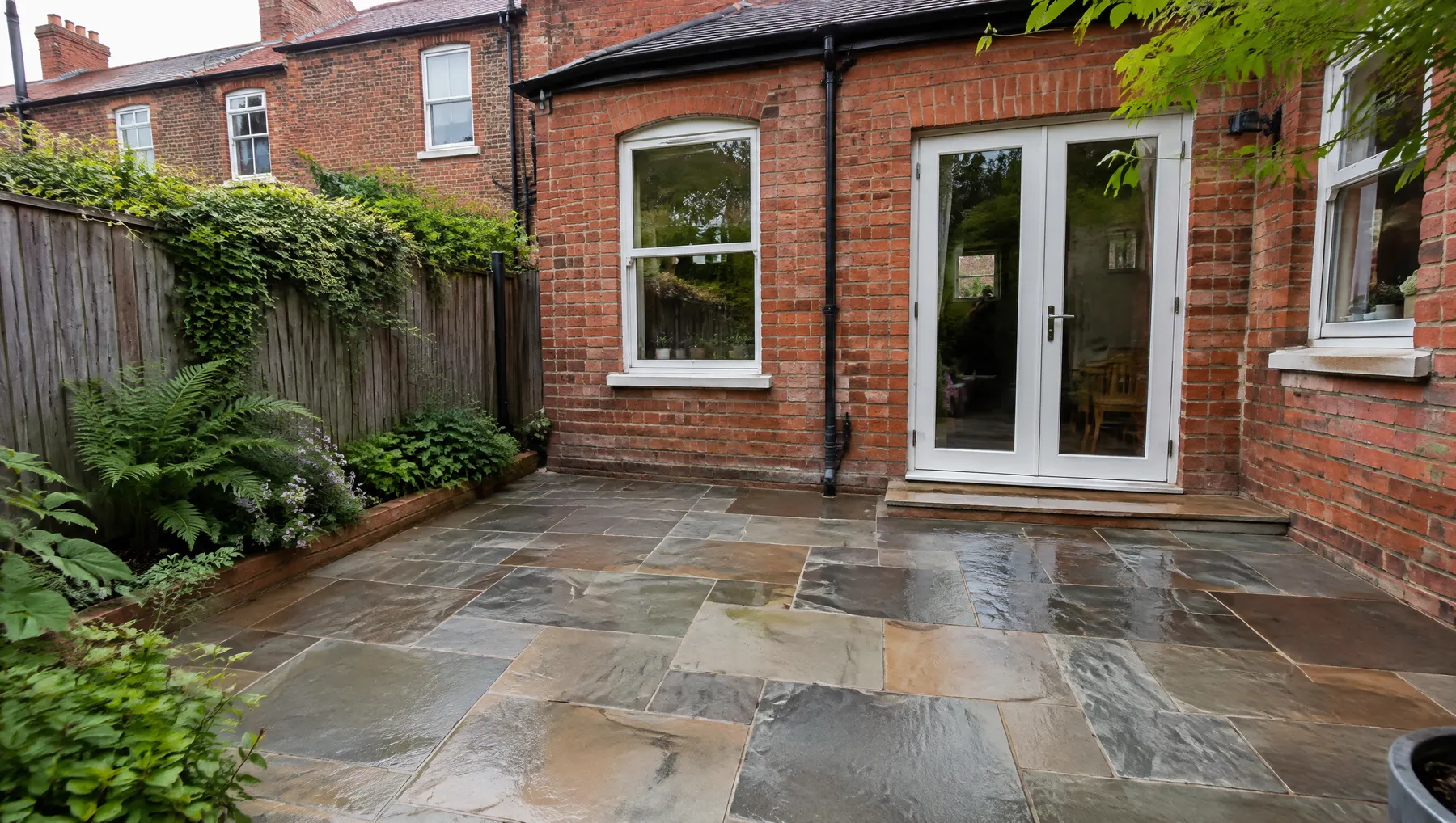
Natural stone patios
Indian sandstone, limestone and slate, laid on a full bed.
Natural stone gives a patio the warmth and variation that manufactured paving cannot quite match. Indian sandstone is the most popular choice in West Midlands gardens, with limestone and slate for a darker, more modern look. We lay natural stone patios across Coventry and the West Midlands, starting with a free site visit to check levels and drainage, then a fixed quote before any work starts.
Indian sandstone: the classic choice
An Indian sandstone patio suits almost any house, from a Victorian terrace to a new build. Every slab is slightly different in colour and texture, so the finished patio looks natural rather than uniform.
It comes in two main finishes. Riven sandstone is split along the natural layers of the stone, giving a textured, uneven surface with good grip. Sawn sandstone is cut smooth with crisp edges for a more contemporary look. Popular colours include grey blends, buff and warmer brown mixes.
- Riven: textured surface, traditional look, good grip
- Sawn: smooth surface, sharp edges, modern look
Limestone and slate
Limestone has a finer, denser grain than sandstone and a calmer, more even appearance. Dark limestones are a popular choice for modern gardens. Some darker limestones can lighten over time in strong sun, and limestone is sensitive to acidic cleaners, so cleaning products need choosing with care.
Slate is dense and dark, often grey, black or with a hint of green or purple. Riven slate has a natural texture and looks striking against a lawn or planting. Try to see any stone wet as well as dry before you choose, because the colour changes a lot when it rains.
| Indian sandstone | Limestone | Slate | |
|---|---|---|---|
| Look | Natural variation, warm or grey tones | Even, refined, often dark | Dark and dense, riven texture |
| Soaks up stains | Yes, can stain and green over | Less than sandstone | Very little |
| Cleaning | Moderate pressure, avoid harsh scrubbing | Avoid acidic cleaners | Straightforward |
| Suits | Most houses and gardens | Modern and minimal designs | Contemporary designs, dark schemes |
How we lay a natural stone patio
Natural stone is laid on a full mortar bed, not on spots of mortar. Spot bedding leaves voids under the slab where water collects, which leads to rocking slabs, cracking and staining. A full bed supports the whole slab.
Before that goes down, we dig out, lay and compact a sub-base, and set the levels so the patio falls gently away from the house. Next to the house, the paving sits at least 150 mm below the damp-proof course so rain cannot cause damp inside. We prime the back of the slabs where the stone needs it, which helps them bond and stops mortar stains coming through.
Joints and staining
Sandstone joints are usually filled with a cement mortar or a brush-in jointing compound. Riven slabs need slightly wider joints to allow for the variation in size.
Sandstone is porous, so mortar smeared on the face can stain it permanently. We keep the faces clean as we work, which is slow, careful work and part of what you are paying for. Some customers choose to seal sandstone afterwards to reduce staining and slow algae growth; it is optional, and we will tell you whether it suits your stone.
Natural stone or porcelain?
Natural stone has more character and is more forgiving to lay. Porcelain is lower maintenance and more uniform. If you are torn, read our guide on porcelain vs Indian sandstone, or see our porcelain patios page.
For what affects the price of each, see our patio cost page.
Sandstone patios across the West Midlands
We lay natural stone patios across the region from Coventry. Areas we cover often include Solihull, Birmingham, Bromsgrove and Coventry. See all our patio services.
What happens, step by step
Free site visit
Book through our quote form. We measure up, check levels and talk through stone choices.
Fixed quote
A written price for the whole patio, with the stone and finish agreed.
Groundwork
Dig out, sub-base and levels, set so water runs away from the house.
Laying and finishing
Slabs laid on a full bed, jointed and cleaned. We tidy up and take the waste away.
What is included
- Free site visit and help choosing the stone
- Dig out and removal of soil and old paving
- Compacted sub-base with falls away from the house
- Slabs laid on a full mortar bed, primed where the stone needs it
- Joints filled with mortar or jointing compound
- Faces kept clean as we lay
- Tidy-up and waste taken away
Natural stone patios FAQs
Is Indian sandstone a good choice for a patio?
Yes, for most gardens. It is hard wearing, looks natural and suits both older and newer houses. It is porous, so it needs an occasional clean, and shady patios green over faster than sunny ones.
Should Indian sandstone be sealed?
It is optional. A sealer reduces staining and slows algae, which helps on shady patios or around a barbecue. Some sealers change the colour slightly, so we talk through the options before deciding.
What is the difference between riven and sawn sandstone?
Riven is split along the stone's natural layers, giving a textured surface. Sawn is cut smooth with straight edges for a modern look.
Why should a patio be laid on a full mortar bed?
A full bed supports the whole slab. Spots of mortar leave hollow gaps where water collects, which can lead to rocking slabs, cracks and staining.
Does limestone fade?
Some darker limestones can lighten over time in strong sunlight. Good quality stone and the right care reduce this, and we will tell you what to expect from the stone you choose.
Can you lay stone patios on a slope?
Yes. Sloping gardens often need steps or retaining edges to create level areas. We plan this on the site visit and include it in the quote.
Natural stone patios near you
We cover the whole West Midlands from Coventry. Pick your town for local details.
Get a fixed price for the job
Tell us what you need and we will come back with a free quote.