
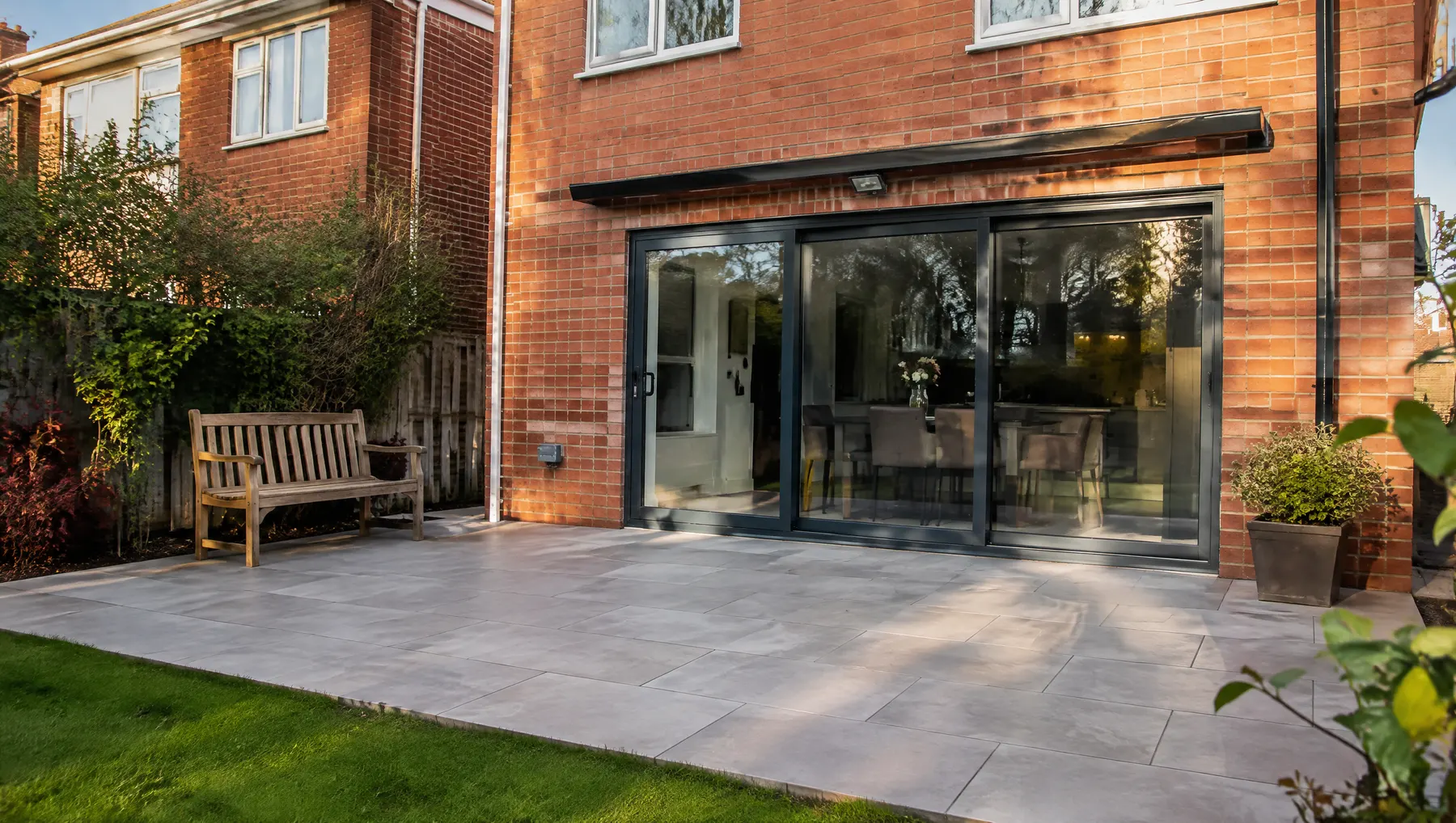
Choose porcelain if you want a crisp, consistent look that barely absorbs water, resists stains and algae and needs little more than a sweep. Choose Indian sandstone if you prefer natural stone with variation in every slab and a softer, traditional feel, and you are happy to clean and reseal it now and then.
Both are popular for good reason, and we lay both across Coventry and the West Midlands. This guide sets out the differences that matter to you, from slip and staining to how each one copes with a shady, damp garden.
At a glance
| Porcelain | Indian sandstone | |
|---|---|---|
| Look | Uniform colour and texture, modern; also stone and wood effects | Natural variation, no two slabs alike, traditional |
| Water absorption | Very low | Porous, takes in moisture |
| Staining | Most marks sit on the surface and wipe off | Can absorb spills such as oil, wine and barbecue fat |
| Algae and moss | Less prone | More prone, especially in shade |
| Sealing | Not normally needed | Periodic sealing advised |
| Fading | Highly UV-resistant | Some colours mellow and weather over time |
| Slip | Outdoor ranges are textured for grip (many rated R11) | Naturally textured riven surface, slippery if algae builds up |
| Laying cost | Slower to lay, so labour usually costs more | Quicker to lay and cut |
| Upkeep | Sweep, wipe spills, occasional wash | Sweep, regular clean, reseal every few years |
Porcelain: the low-maintenance option
Outdoor porcelain is made by firing clay at very high temperature, which leaves a dense slab that absorbs very little water. Bradstone describes it as resistant to scratches, stains and fading, with highly consistent colours and textures.
That low absorption is what makes porcelain so easy to live with. Marshalls notes that stains tend to stay on the surface rather than soaking in, so most spills wipe off with a damp cloth and a little detergent. Its outdoor ranges are rated R11 for slip resistance, and the printed finish is highly UV-resistant even in strong sun.
Because it is consistent, porcelain suits clean lines, large format slabs and modern extensions with big glass doors. Many ranges also mimic stone, slate or timber, which lets you get a natural look without the upkeep.
The downsides
Porcelain is harder to lay well. It does not bond to mortar the way stone does, so each slab needs a primer or slurry on the back and a full bed of mortar underneath, with no hollow spots. It is also hard to cut, needing diamond blades and patience, which adds labour on curves and around drains.
Some smoother porcelain finishes can feel slick when wet, so check the slip rating on the range you like, especially for steps and paths.
Indian sandstone: the natural option
Indian sandstone is a quarried natural stone, usually with a riven (split) face. Popular colours include grey, buff, brown and green-tinged blends, and every slab carries its own markings. For a cottage garden, a period home or anyone who likes paving that looks as if it has always been there, it is hard to beat.
Sandstone is more forgiving to lay. It bonds well to mortar, cuts easily, and slight variations in thickness are part of its character. Bradstone calls natural stone generally more forgiving in its installation, and says it can last for decades if properly cared for.
The downsides
Sandstone is porous. Bradstone notes that moisture seeps in easily, which is why periodic sealing is advised. It is also more prone to moss, algae and white salt marks over time, and it can weather and wear more noticeably than porcelain.
In a north-facing or tree-shaded garden, an unsealed sandstone patio can turn green and slippery within a year or two. Spills such as barbecue fat or red wine can soak in if not cleaned quickly.
Cleaning and long-term care
Porcelain mostly needs sweeping and the odd wash. Marshalls says it does not need jet washing for routine care, and spills should be spot-cleaned.
Sandstone needs a little more effort. Marshalls advises brushing regularly to remove debris, using a low-pressure setting if you do pressure wash, and avoiding acid-based cleaners, which can cause rust-coloured marks on the stone. A good sealer, applied once the patio has fully dried, makes stains and algae easier to deal with.
Steps, edges and linking inside to outside
Many porcelain ranges come with matching indoor tiles, so a kitchen floor can run straight out through bifold doors onto the patio in the same colour. That flowing look is hard to achieve with natural stone, which varies from batch to batch.
Sandstone has the edge on steps, walls and edging. It can be cut and shaped on site to fit curves and odd angles, and the cut edges look natural. Porcelain steps need careful detailing, and cut edges can look sharp unless they are finished properly, so ask how steps and edges will be handled before you choose.
Which suits your garden?
- Modern home, large glass doors, minimal upkeep wanted: porcelain, ideally in a large format.
- Period house, cottage garden or traditional look: Indian sandstone.
- Shady, damp garden or under trees: porcelain is easier to keep clean and safe.
- Families who barbecue and eat outside a lot: porcelain, for stain resistance.
- Curves, circles and lots of cutting: sandstone is easier to shape.
The base matters more than the slab
Whichever you choose, the patio will only be as good as what is underneath it. Across much of the West Midlands that means heavy clay that holds water, so we dig out properly, lay a compacted sub-base and set a fall so rain runs away from the house rather than towards it.
Our porcelain patios page explains how we lay porcelain with a full bed and primer, and our natural stone patios page covers sandstone and other stones. For what moves the price, read our patio cost guide, then book a free site visit for a fixed quote.
Frequently asked questions
Is porcelain paving slippery?
Outdoor porcelain is made with a textured finish, and many ranges carry an R11 slip rating. Smoother finishes can feel slick when wet, so check the rating for steps and paths. Any paving gets slippery if algae or dirt builds up, so keep it swept.
Does Indian sandstone need sealing?
It is a good idea. Sandstone is porous, so a sealer helps stop stains soaking in and slows algae. It should go on once the patio is fully dry and will need redoing every few years. Porcelain does not normally need sealing.
Which is cheaper, porcelain or Indian sandstone?
It depends on the range you pick and the size of the job. Porcelain usually costs more to lay because it needs primer, a full mortar bed and slower diamond cutting. We give a fixed price after a free site visit, so you can compare both for your garden.
Can you pressure wash Indian sandstone?
Yes, gently. Use a low-pressure setting, keep the lance at an angle and do not blast the surface or the joints. Avoid acid cleaners, which can leave rust-coloured marks. A stiff brush and a mild detergent handle most routine dirt.
Does porcelain fade in the sun?
Good outdoor porcelain is highly UV-resistant, so its colour holds well, even in full sun. Natural sandstone tends to mellow and weather over time, which some people like and others do not.