
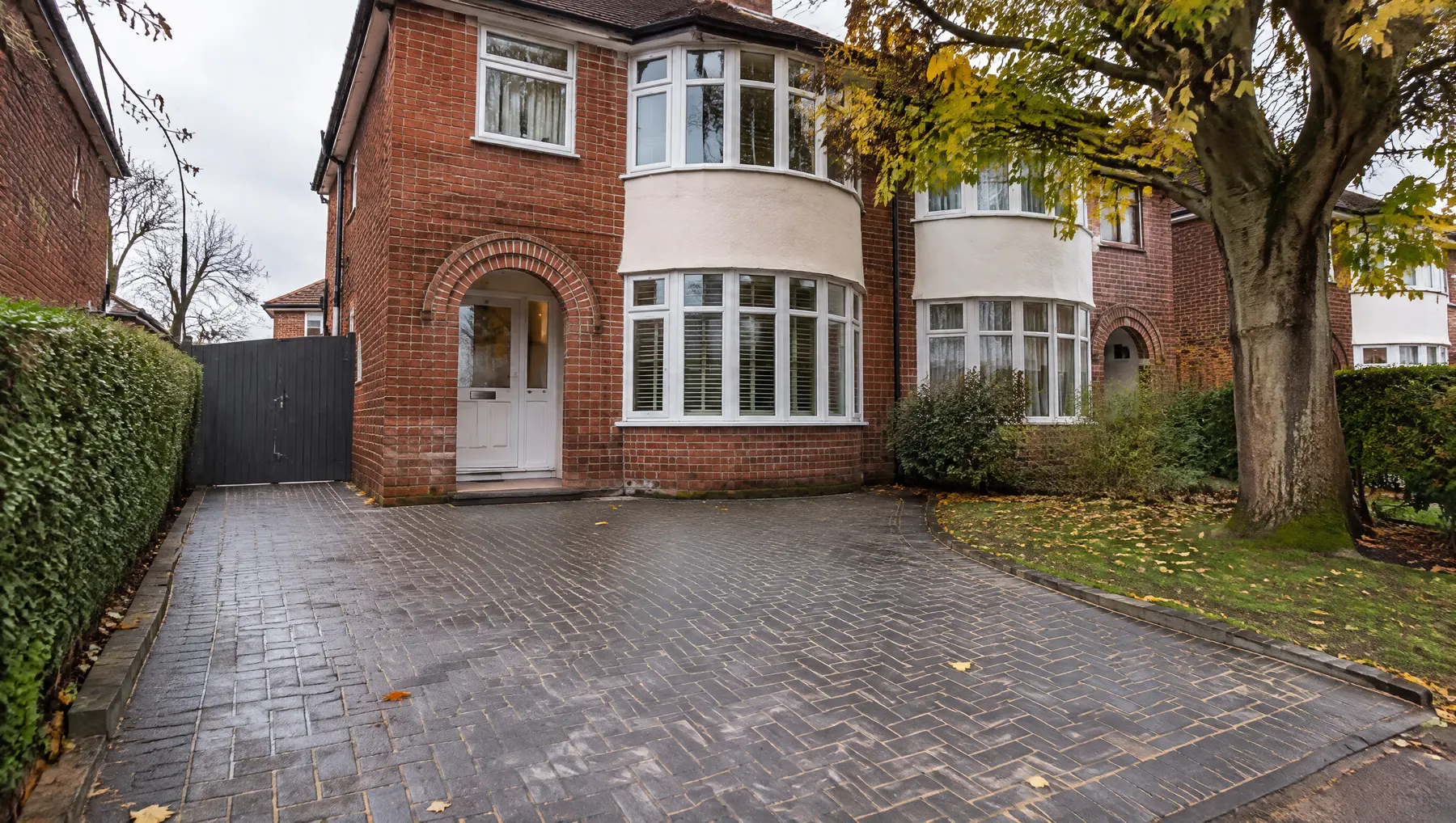
Most driveways need a deep clean about once a year, plus a quick sweep every few weeks to stop dirt and leaves settling into the joints. Drives under trees, in heavy shade or on a north-facing plot often need a clean every six to nine months, while a sunny, open drive can sometimes go 18 months or more.
That is a rule of thumb from over 13 years of cleaning drives across Coventry and the West Midlands, not a fixed schedule. The surface, what grows near it and how you use it matter more than the calendar.
A quick guide by surface
Different surfaces hold dirt in different ways. Block paving traps it in the joints, tarmac lets oil sink in, and resin shows green tinges in shady corners. Use the table as a starting point, then adjust for your own drive.
| Surface | Sweep | Deep clean (typical) | What builds up first |
|---|---|---|---|
| Block paving | Every 2 to 4 weeks | Every 12 months, re-sand after | Weeds and moss in the joints, black algae on shaded blocks |
| Tarmac | Monthly | Every 12 to 18 months | Oil stains, moss at the edges, loose chippings |
| Resin bound | Monthly | Every 12 to 24 months | Green algae in shade, leaf staining, tyre marks |
| Concrete or imprinted concrete | Monthly | Every 12 months | Algae, grey film, flaking sealer on imprinted drives |
| Natural stone paths and steps | Every 2 to 4 weeks | Every 12 months, low pressure only | Algae, lichen spots, slippery patches |
Those intervals assume a normal family drive with a car or two on it. A drive that takes a work van, a caravan or a lot of foot traffic to the front door will need attention sooner.
What makes a drive need cleaning more often
Shade and aspect
Algae and moss love damp surfaces that never quite dry out. A north-facing drive, or one squeezed between two houses, can stay wet for days after rain. On those drives we often see a green film come back within six months of a clean.
Trees and hedges
Overhanging trees drop leaves, seeds, sap and bird droppings. Leaves left to rot stain light paving brown and feed weeds in the joints. Sycamore and lime are the worst offenders for sticky sap, and they are common on older streets right across the region.
Soil, slope and run-off
Where a lawn or border sits higher than the drive, rain washes soil across the surface every time it pours. That silt packs into the joints, and weed seeds take hold in it. A drive at the bottom of a slope will need more frequent attention than one at the top.
How you use it
Cars that sit in the same spot for months leave oil drips and tyre marks. Wheelie bins dragged across the same line wear a dirty track. If you park on the drive every day, expect the parking bay to look tired well before the rest of it.
Signs your drive is overdue a clean
- Weeds or moss growing in more than the odd joint.
- A green or black film that feels slippery underfoot when wet.
- Joints that look empty or sunken, so the blocks start to rock.
- Dark oil patches that have spread rather than faded.
- Puddles forming where they never used to, which can mean blocked joints or a clogged resin surface.
- The colour of the paving looks flat grey compared with a slab hidden under a pot.
Slipperiness is the one to take seriously. A slimy front path is a fall waiting to happen, especially for older relatives or anyone carrying shopping in winter.
Can you clean it too often?
Yes, if every clean means a high-pressure blast. Marshalls' technical guidance says power washing with high-pressure equipment is not normally needed for routine care, and recommends regular sweeping instead to stop dirt building up. Washing too hard, too often, can strip jointing sand and wear the surface of some concrete blocks.
The best routine is little and often in between: a stiff broom, a scrape of the joints where weeds start, and leaves cleared before they rot. Then one thorough clean a year, done at the right pressure, followed by re-sanding where it is needed.
The best time of year to clean a driveway
Late spring and early autumn are the sweet spots. Spring cleans clear the winter algae and get the drive looking right for summer. Autumn cleans remove moss before it spreads over the wet months and give re-sanded joints time to settle before frost.
We avoid cleaning in hard frost. Water left in joints and on the surface can freeze, and kiln-dried sand will not brush in properly on a surface that never dries. A dry spell of a day or two after the clean makes re-sanding far more effective.
Keeping a clean drive looking good for longer
- Sweep every few weeks, more often in autumn when leaves fall.
- Pull or scrape out weeds while they are small, before roots open up the joints.
- Top up jointing sand on block paving whenever joints look low.
- Deal with oil drips quickly with a degreaser and a stiff brush, before they soak in.
- Cut back overhanging branches where you can, to let light and air reach the surface.
- Keep any drains along the edge of the drive clear so water runs off rather than sitting.
On block paving, sealing after a deep clean can help. A sealer binds the top of the jointing sand, so weeds struggle to root and the sand is less likely to wash out. It is not compulsory, and it does need redoing every few years, so we talk it through on site rather than adding it by default.
DIY or a professional clean?
A small, lightly soiled drive is a fair DIY job with a domestic pressure washer and a patio cleaner attachment. Follow the manufacturer's advice on pressure and angle, test a corner first, and keep the lance moving.
Bigger drives, heavy moss, oil staining and anything that needs re-sanding are where a professional clean earns its keep. Our driveway cleaning service covers the whole surface evenly, so you are not left with stripes or patches, and we re-sand block paving properly afterwards. If your drive is block paved, our page on block paving cleaning and re-sanding explains the full process.
Many customers book the drive and the back garden at the same visit. Our patio cleaning works the same way, with lower pressure settings for natural stone. You can see everything we do on the jet washing page, or ask for a free quote.
Frequently asked questions
How often should block paving be re-sanded?
Top it up whenever the joints look low, and always after a deep clean, because washing lifts some of the sand out. On a typical family drive that means a proper re-sand once a year with kiln-dried sand, plus the odd top-up where weeds have been pulled or water runs off a lawn.
Is once a year enough for a drive under trees?
Often not. Leaves, sap and shade let algae and moss return quickly, so a drive under mature trees may need cleaning every six to nine months. Regular sweeping in autumn makes a big difference and can stretch the gap between deep cleans.
Does sealing mean I can clean less often?
It helps. A sealer locks the top of the jointing sand, which slows weed growth and makes surface dirt easier to sweep off. You will still need the odd clean, and the sealer itself wears and needs reapplying every few years.
What time of year is best for a driveway clean?
Late spring or early autumn, in a dry spell. That gives the surface time to dry so jointing sand brushes in properly, and it avoids frost getting into wet joints. We do not clean in hard frost.
Will regular pressure washing wear out my drive?
It can if it is done at high pressure too often. Manufacturer guidance recommends medium pressure at most for paving, with the lance held at an angle and back from the surface. Routine sweeping in between keeps the number of deep cleans down.